
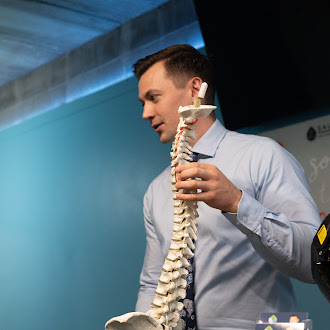
Have you ever looked at the model of the human spine in our office and thought, “There’s a lot going on in there!”?
You’re absolutely right. And that’s probably an understatement!
Your spine is much more than a stack of bones running down your back. It’s a remarkable structure made up of bones, joints, discs, muscles, ligaments, and nerves that all work together.
Your spine has several important jobs. It supports your body, allows you to move, and protects your spinal cord—one of the body’s most important communication pathways.
And here’s something I often explain to patients at Sauk Spine Chiropractic: Structure affects function.
Understanding how your spine is built can help you understand how it moves, why certain problems develop, and why we may recommend different approaches to chiropractic care.
Let’s take a closer look.
Your Vertebrae: The Building Blocks of Your Spine
Your spine isn’t one long, solid bone. It’s made up of individual bones called vertebrae, arranged in sections.
-
Cervical spine: Seven vertebrae in your neck that support your head and allow you to look up, down, and side to side.
-
Thoracic spine: Twelve vertebrae through your upper and middle back, where your ribs attach.
-
Lumbar spine: Five larger vertebrae in your lower back that carry a significant amount of your body’s weight.
-
Sacrum and coccyx: The bones at the base of your spine that help connect your spine to your pelvis.
Why does this arrangement matter?
Think about everything you ask your spine to do in a typical day. You bend to put on your shoes, turn to look over your shoulder while driving, reach into a cupboard, and lift groceries out of the car.
Your spine needs to be strong enough to support you, but flexible enough to allow all that movement.
Small joints between your vertebrae, called facet joints, help guide and control how different sections of your spine move.
When those joints aren’t moving comfortably or normally, everyday activities can become more difficult. You may notice stiffness, muscle tension, or discomfort when performing movements that used to feel effortless.
That’s one reason we pay attention to how your spine moves, not just where it hurts.
Your Spinal Discs: More Than Just Cushions
Between most of your vertebrae are structures called intervertebral discs.
I often describe these as tough, flexible cushions between the bones of your spine.
Each disc has a strong outer ring of fibrous tissue surrounding a softer, gel-like center. Together, these structures help distribute forces and allow movement between your vertebrae.
Your discs handle quite a bit of work throughout your lifetime!
As we age, discs naturally change. Injuries, genetics, and the demands we place on our bodies can also influence disc health.
You may have heard terms like bulging disc, herniated disc, or degenerative disc disease. These describe different changes that can occur in the discs, although those changes don’t always cause pain.
Here’s something interesting: Most spinal discs have a limited direct blood supply. They rely largely on the movement of fluids and nutrients through surrounding tissues to maintain their health.
Appropriate movement and normal changes in pressure help support that process.
It’s another reason I encourage patients to think about movement as an important part of caring for their spine.
Your Spine and Nervous System: An Important Relationship
Now let’s talk about something especially important.
Running through the protective canal formed by your vertebrae is your spinal cord.
Your spinal cord and brain make up your central nervous system. Together, they help your body receive information, process it, and coordinate responses.
Think of your nervous system as an incredibly sophisticated communication network.
Spinal nerves branch from the spinal cord and pass through openings between your vertebrae. These nerves help carry information about sensation, movement, and other bodily functions.
That’s a pretty important job!
Certain spinal conditions, such as a herniated disc or narrowing around a nerve, can sometimes irritate or compress spinal nerves. Depending on which nerves are affected, symptoms may include pain, tingling, numbness, or weakness.
But not every ache or pain means there’s a pinched nerve. And not every spinal change causes symptoms.
That’s why a careful evaluation matters.
At Sauk Spine, we’re interested in understanding how your spine is functioning, whether nerves may be involved, and what might be contributing to the symptoms you’re experiencing.
Your spine does more than help you stand upright. It protects an essential part of your nervous system while allowing you to move through daily life.
Muscles, Ligaments, and Other Soft Tissues: The Supporting Team
We spend a lot of time talking about bones, joints, and discs, but there’s another important part of the picture.
Your spine couldn’t do its job without the muscles and other soft tissues surrounding it.
Muscles create and control movement while helping support your posture.
Ligaments connect bones and provide stability to your joints.
Tendons connect muscles to bones, allowing muscular forces to produce movement.
Fascia is connective tissue that surrounds and supports muscles and other structures throughout your body.
These tissues work together every time you move.
Let’s say you’ve been sitting at a computer for several hours. You might notice tension developing across your shoulders or discomfort in your lower back.
That doesn’t necessarily mean something is damaged. Your muscles may simply be responding to prolonged positioning, fatigue, or the way you’re using your body.
On the other hand, persistent pain or restricted movement may involve several structures working together.
That’s why I don’t want to know only where you’re hurting.
I also want to know when the discomfort started, what makes it better or worse, and how it’s affecting your everyday activities.
Those details help us understand the bigger picture.
Where Does Chiropractic Care Fit In?
Now that we’ve covered some basic spinal anatomy, let’s connect it to the care we provide at Sauk Spine Chiropractic.
One of the things I want patients to understand is that different treatments have different purposes.
We don’t necessarily use the same approach for every person or every condition.
Chiropractic Adjustments
A chiropractic adjustment involves applying a controlled force to a specific joint.
Adjustments are intended to improve joint mobility and function and may help reduce certain types of musculoskeletal pain.
For some patients, restricted or uncomfortable joint movement is an important part of what we’re addressing.
[Learn more: What Happens During a Chiropractic Adjustment?]
Spinal Decompression
Spinal decompression therapy uses controlled traction to apply gentle pulling forces to targeted areas of the spine.
Depending on the condition, this approach may be considered for certain patients experiencing disc-related symptoms or some types of nerve irritation.
It’s important to understand that decompression isn’t appropriate for everyone, and results vary. We consider your symptoms, examination findings, and health history before recommending it.
[Learn more: Understanding Spinal Decompression Therapy]
Spinal Intersegmental Traction
You may have heard us refer to this as the roller table.
Spinal Intersegmental Traction uses a specialized table with rollers that gently move beneath your back, providing passive movement along different areas of the spine.
Patients often find it relaxing. It’s used to encourage gentle spinal movement and may help with temporary muscle tension or stiffness.
It isn’t the same as a chiropractic adjustment or spinal decompression, and it serves a different purpose within a care plan.
[Learn more: What Is Spinal Intersegmental Traction?]
Why We Look at the Whole Picture
Here’s what I hope you’re beginning to see.
Your vertebrae don’t work independently of your discs.
Your joints don’t work independently of your muscles.
And your spine doesn’t function separately from the nervous system it surrounds and protects.
It’s all connected.
When I evaluate a patient, I’m not simply looking for one spot that hurts. I’m considering how the different parts of the spine are functioning, what may be contributing to the symptoms, and how those symptoms are affecting daily life.
Sometimes the most appropriate approach involves chiropractic adjustments. Sometimes another therapy may be helpful. And sometimes examination findings tell us that additional testing or a referral to another healthcare professional is the better next step.
The goal is to recommend care that makes sense for your particular situation.
Understanding Your Spine Helps You Take Better Care of It
You don’t need to memorize the names of every vertebra or understand every detail of spinal anatomy.
But I do believe that when you understand a little more about how your body works, you’re better equipped to make informed decisions about your health.
That’s the purpose of our Sauk Spine Patient Education series.
In the articles ahead, we’ll walk through what to expect during your first visits, explain chiropractic adjustments and other treatment options, and explore how different approaches may fit together in a personalized care plan.
My goal is simple: I want you to understand what we’re doing, why we’re recommending it, and how it relates to your health and movement.
Because the more you understand your spine, the better prepared you are to take an active role in caring for it.
Have questions about your spine or whether chiropractic care may be appropriate for you? Contact Sauk Spine Chiropractic in Sauk City. We’re happy to help you take the next step.